The short answer
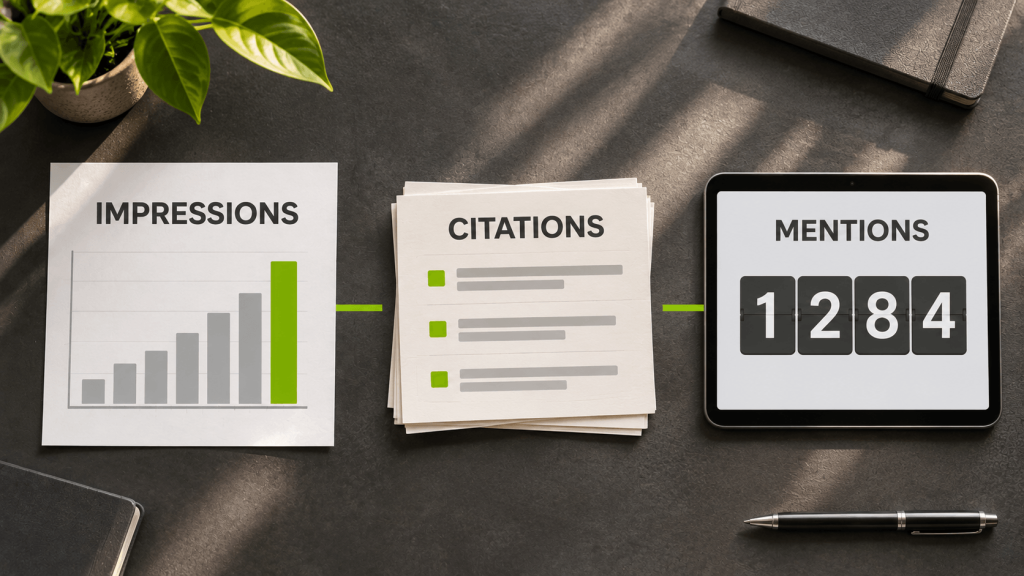
Three first-party instruments exist. Google Search Console reports impressions inside generative AI features. Bing Webmaster Tools reports citations and citation share, and its own documentation states that the data is a sample. OpenAI’s Business Hub, launched November 10, 2026, reports mentions and website clicks over a rolling 28-day window, with two different definitions of “mention” depending on whether the business is online or local. No single number covers all three. Each instrument answers a different question, in a unit the other two do not report.
“AI visibility” is not one number
The phrase “AI visibility” is used as if it names a single measurable thing. It does not.
Google counts impressions: the number of times your pages appeared inside a generative AI feature on Search. Bing counts citations: the number of times your pages were displayed as sources inside an AI-generated answer. OpenAI counts mentions: defined one way for online businesses and a different way for local ones. A standards body, the IAB, published a 37-page framework in August 2026 cataloging more than 20 companies selling AI visibility tools, each using different methodologies and producing different answers for the same brand or publisher.
An impression is not a citation. A citation is not a mention. A mention that counts because a listing was surfaced, even without a click, is not the same as a mention that requires a website reference. When a tool reports “your AI visibility score”, the first question is: which of these units is it counting, over which surfaces, and with what denominator?
A single composite score hides which question was answered. Before you can measure AI visibility, you need to decide which question you are actually asking.
| Instrument | Unit reported | What it does NOT report |
|---|---|---|
| Google Search Console | Impressions | Surface (AI Overviews vs AI Mode not separable) |
| Bing Webmaster Tools | Citations, citation share | Traffic, competitor domains, quality scores |
| OpenAI Business Hub | Mentions, website clicks | Individual prompts, per-article breakdown, competitor data |
Google Search Console: impressions inside generative AI features
On June 3, 2026, Google announced “dedicated views of your impressions within generative AI features on Search.” The rollout completed globally on August 31, 2026.
The data was not new. Google was explicit: “This data is included in the overall performance report, where it will continue to be tracked to give site owners an overview.” What changed was the view, not the underlying measurement. Google described it as: “Today, we are launching a separate view dedicated to visibility from generative AI features.”
The features covered are “such as AI Overviews and AI Mode, as well as generative AI features in Discover.” The dimensions available are Pages, Countries, Devices, and Dates.
What the report lists as its metric: impressions. The report offers no surface dimension, so AI Overviews and AI Mode are not separable within it. If you need to know which surface drove a given impression count, the report does not answer that question.
Two things worth noting before you build a reporting process around this data:
- Search Console definitions have changed before, and the generative AI view is recent enough that its scope may shift again.
- The data was already counting inside your totals. If your overall impression numbers rose after August 31, 2026 without a corresponding position improvement, the generative AI view is the first place to check whether the mix shifted.
The generative AI view answers one question: how often did Google’s AI features show your pages? The report lists one metric, impressions. It does not answer which feature showed them or how you compared to anyone else.
Bing Webmaster Tools: citations and citation share
Bing launched its AI Performance dashboard in public preview on February 10, 2026, and added citation share, intents, topics, and period comparisons on June 16, 2026. It reports across “Microsoft Copilot, AI-generated summaries in Bing, and select partner integrations.”
The two primary metrics:
- Total Citations: “Shows the total number of citations that are displayed as sources in AI-generated answers during the selected time frame.”
- Citation Share: “It is calculated as the percentage of citations attributed to your site out of all citations shown across all sites” for the same grounding query.
The grounding query dimension is what makes Bing’s data actionable. It “shows the key phrases the AI used when retrieving content that was referenced in AI-generated answers.” That is the bridge between what a user asked and which pages were surfaced.
The most important caveat in the entire instrument set, in Bing’s own words: “The data shown represents a sample of overall citation activity.”
That sentence changes how you read every number in the dashboard. A citation count is not a census. It is a sample of a larger pool whose full size is not disclosed.
Two additional constraints Bing states directly:
- “It does not expose competitor domains, represent traffic share, or assign quality scores to content.”
- “Citation share is designed as an observational metric, not a ranking system or a competitive scoreboard.”
“Citation activity can be influenced by many factors including evolving AI models, competing content, freshness signals, and shifts in user demand.” The dashboard also carries a preview caveat: “During the preview phase, some labels may still be broad.”
Prompt tracking inside Bing’s grounding query data is where the most specific measurement work happens, and it is also where the contamination traps below live.
ChatGPT: the instrument that arrived last, and what it still will not tell you
OpenAI launched Business Hub on November 10, 2026. It includes an Insights panel. As documented on November 25, 2026, this instrument is in beta by OpenAI’s own word, and the data, the definitions, and the coverage are new and moving.
“Business Hub provides aggregated insights into how people engage with a business in ChatGPT.” The window is fixed: “Insights show aggregate activity over the past 28 days, including mentions and website clicks.”
The two definitions of “mention” sit in the same panel. For an online business: “a mention counts when ChatGPT references the business’s website. The brand name alone doesn’t count.” For a local business: “a mention counts when ChatGPT shows a result for that location, even if the customer doesn’t open the listing or visit the website.” One word, two denominators, in the same interface. That is this article’s thesis written by the vendor.
What Business Hub does not report, per OpenAI’s own documentation:
- “Businesses don’t receive individual prompts or consumer conversations.”
- Discovery themes “don’t reveal individual prompts or directly measure customer intent.”
- “Counts may be incomplete.”
- “A blank metric can mean activity hasn’t reached the reporting threshold, data is still being collected, or reporting is unavailable.”
No export and no API are documented. Access is gated behind claiming the business plus Persona identity verification.
On the crawler side, OpenAI documents four bots with distinct purposes. OAI-SearchBot is “used to surface websites in search results in ChatGPT’s search features.” GPTBot is “used to make our generative AI foundation models more useful and safe.” ChatGPT-User is “not used for crawling the web in an automatic fashion” and “not used to determine whether content may appear in Search.” OAI-AdsBot is “used to validate the safety of web pages submitted as ads on ChatGPT.”
“Responses that use web search may include citations.” “Placement is not guaranteed.”
A blank in Business Hub Insights is not a zero. It may mean the threshold has not been reached, or that data collection is still in progress. Before concluding your brand is absent from ChatGPT, that distinction matters.
What happened when we measured our own site with two of them
The tables below join Bing AI Performance citations against Google Search Console impressions on our own site. No anonymization is needed because the data is ours.
Two windows, stated upfront: Bing figures are year-to-date as of November 24, 2026. GSC figures are the 90-day window from August 24 to November 21, 2026. They are not the same period, and Bing’s own documentation calls its data a sample. Read the comparison as directional, not as a census.
Pages Bing cites most, against Google
| Page | Bing citations (YTD) | GSC impressions (90d) | GSC position |
|---|---|---|---|
/answer-engine-optimization-starts-with-structure/ | 489 | 165 | 43.0 |
/googles-evolving-product-search.../ | 292 | 701 | 37.8 |
/services/answer-engine-optimization-aeo/ | 149 | 201 | 28.8 |
/from-zero-to-hero.../ glossary pages | 139 | 513 | 12.9 |
/your-google-search-console-data-just-changed-forever/ | 28 | 1,290 | 43.5 |
Pages Google shows most, against Bing
| Page | GSC impressions (90d) | Bing citations (YTD) |
|---|---|---|
/featured-snippets-transforming-search-results.../ | 2,649 | 0 |
/glossary/seo-funnel/ | 1,357 | 0 |
/your-product-lives-in-fifteen-places.../ | 660 | 0 |
/the-best-aeo-agency-may-not-be-the-one-with-the-best-pitch/ | 611 | 0 |
Our most AI-cited page, 489 citations, sits at average position 43 in Google on 165 impressions.
Our highest-impression page, 2,649 impressions, has zero AI citations.
This is one site, over these windows. It is not a law. For attribution purposes, it is a reason to treat the two instruments as separate questions rather than as two reads on the same thing. For the causal explanation of why a ranking page still does not get cited, that is a separate argument and a separate page.
Only 19 of our 63 published posts are cited by Bing at all. That bounds the comparison: the divergence in the tables above is not an outlier. It is the norm.
Referral analytics will show you some AI traffic, but the channel definitions differ between analytics platforms and have been changing. Check in your own property which assistants your analytics counts as AI traffic and which it files elsewhere, because the label is not self-explanatory and a channel that looks complete may exclude a whole surface.
Five ways the number moves without the thing moving
A rising citation count or impression total is not evidence that your AI visibility improved. Five specific mechanisms produce movement in the number without any change in the underlying thing being measured.
(a) Rank-tracker pollution
Bing’s grounding query export includes queries that are not user questions at all. In our own Bing query data, 221 of 730 rows match the pattern of a numeric ID followed by a colon and a keyword, for example 11039: seo funnel at 81 impressions. These are rank-tracker pings, not user queries. Of the remaining 509 clean distinct queries, the total impressions come to 1,590. If you report from the raw export without filtering this pattern, your baseline is inflated from the start.
(b) Prompt-shaped query contamination
Some queries in the grounding data look like prompts because they are prompts, injected by tools that test AI responses at scale. On our own property, measured at two windows on October 13, 2026, prompt-shaped queries accounted for 10.8% and 9.9% of grounding query rows respectively. A citation count that includes these rows is measuring tool activity, not user demand.
(c) A single AI query is a sample of one
AI answers are non-deterministic. The same query run twice can produce different citations, different sources, and a different mention count. An absence in one run is not an absence in general. Any measurement that records a single response per query and reports it as a rate has not measured a rate. It has measured one draw from a distribution.
(d) The immature tail
In both GSC and Bing AI Performance, the most recent days under-report. Data at the trailing edge of any export is incomplete. A drop at the right edge of a chart imitates both a decline and diminishing returns. Before concluding that a page’s performance is falling, check whether the apparent decline begins in the immature window.
(e) A prompt set you chose yourself flatters you
The IAB framework, published August 3, 2026, puts the general case plainly: “The failure is in treating directional data as decision-grade without recognizing the gap.” The prompt selection problem is a specific version of that failure.
On our own site, in the same week, prompt tracking across two queries produced opposite results. On glossary pages SEO visibility, citation share was 40.56%, with 73 citations in a pool of approximately 180. On answer-first formatting vs traditional content structure, citation share was 0.86%, with 214 citations in a pool of approximately 24,900. Same site. Same week. The difference is query breadth, not performance. A narrow or branded prompt set scores high and measures nothing a buyer would actually ask.
The IAB framework is also revealing in what it leaves out. It catalogs more than 20 vendors and never once names Search Console, Bing Webmaster Tools, Citation Share, Business Hub, or any first-party instrument a site owner already holds. It is a vocabulary for judging the vendors you might buy. It says nothing about the three reports you already own.
Choosing the window: three question types
The right measurement window depends on the question, not on a platform cycle. Three question types, three different answers.
Observed state: no window required. If the question is whether a page is indexed, whether structured data is live, or whether a crawler has visited, check immediately. There is no minimum accumulation period. Either the state is true or it is not.
Rate metrics: 28 days minimum. If the question is about a rate, such as conversion, ROAS, or CPA, you need at least 28 days to account for day-of-week variation and conversion import lag. A 14-day window for a rate metric will misread a weekly pattern as a trend.
Leading indicators: directional at 14, decision at 28. Impressions, citations, and position are leading indicators. At 14 days the data is directional: enough to confirm a direction, not enough to make a budget or content decision. At 28 days it is decision-grade.
Why multiples of seven? Day-of-week seasonality. Search behavior on a Monday differs from search behavior on a Saturday, and AI query patterns follow the same weekly shape. A window that is not a multiple of seven compares different day mixes and produces a number that is partly a calendar artifact. This is not an algorithm cycle. It is basic sampling discipline.
| Question type | Minimum window | Decision window |
|---|---|---|
| Observed state (indexed, schema live, crawled) | Immediate | Immediate |
| Rate (conversion, ROAS, CPA) | 28 days | 28 days |
| Leading indicator (impressions, citations, position) | 14 days (directional) | 28 days |
What to do on Monday
Three instruments, three logins, one morning.
- Open Google Search Console. Go to the generative AI performance view. Record your impressions total and note that it is already inside your overall report totals. Set a 28-day comparison period.
- Open Bing Webmaster Tools. Go to AI Performance. Export the grounding query data. Before you read any citation count, filter out rows matching the
^[0-9]{3,6}:pattern. The clean rows are your baseline. - Open OpenAI Business Hub Insights, if your business is eligible and claimed. Record mentions and website clicks. Note which definition of “mention” applies to your business type. Note that the window is fixed at 28 days and that a blank is not a zero.
- Check your referral analytics to see which AI assistants your property is counting and which it is filing elsewhere. Do not assume the label is complete.
- Set a 28-day reminder. Leading indicators need a full window before they are decision-grade. Record today’s numbers as the before-state.
That is the measurement protocol. This article stops at measurement. If the numbers surface a gap, the next question is why, and that is a different problem. Answer engine optimization is where the fixing work begins. If you need a structured read of your current AI search visibility across all three instruments, our analytics and reporting service is where to start.
Three reports. Three units. One read you can take to a board.
We pull all three first-party instruments, filter the tracker noise out of the grounding data, and state the source and the window next to every number. You get what each instrument says, and what it cannot tell you.
See how we measure AI search visibility Measured, and the numbers are flat? That is a different job. Answer Engine Optimization.Frequently Asked Questions
Google Search Console shows rising AI impressions but Bing shows flat or falling citations. Which number do I report to leadership?
Report both, labeled by instrument and unit. An impression in Google’s generative AI view and a citation in Bing AI Performance are not the same thing, and averaging or choosing one suppresses information that may be strategically important. If leadership needs a single number, the honest framing is to pick the instrument that answers the business question on the table: impressions if the question is about Google AI feature presence, citations if the question is about Copilot and Bing AI sourcing. State which surface the number covers and which it does not.
A competitor is publicly quoting their AI citation count as evidence of market leadership. Can that number be trusted?
Not without knowing the source, the window, and whether the grounding query data was filtered. Bing’s own documentation states that citation data is a sample, not a census. A raw export that includes rank-tracker rows will inflate the count. A count that covers only branded or narrow queries will score higher than one covering broad buyer queries. Without knowing those three things, a quoted citation count is a directional signal at best and a marketing claim at worst.
Some surfaces have no publisher-facing reporting at all. How do you measure visibility where you get nothing back?
You measure indirectly. Referral analytics will show sessions from some AI assistants, though the channel labeling varies by platform and has been changing. Structured prompt testing, running a fixed set of queries manually or through a third-party tool and recording whether your pages appear, gives you a presence rate across runs. The IAB framework calls programs running fewer than 50 queries per measurement program “exploratory rather than directional.” That ceiling applies here: a small prompt set on an unreported surface produces directional data, not decision-grade measurement. If you need measurement that covers what the three first-party instruments do not, our analytics and reporting service builds a structured read across the surfaces we can observe, including those with no native reporting.
What does a zero actually mean in any of these instruments?
It depends on the instrument. In Google Search Console, a zero impression count for a page in the generative AI view means Google did not record that page appearing in an AI feature during the selected window, which may reflect genuine absence, a window too short to accumulate data, or a page that Google’s AI features have not yet indexed or evaluated. In Bing AI Performance, zero citations may mean no citations in the sampled data, not no citations in total, because the data is a sample. In OpenAI Business Hub, a blank metric explicitly means one of three things per OpenAI’s own documentation: the threshold has not been reached, data is still being collected, or reporting is unavailable. Zero and blank are not the same, and neither is the same as absent.
How long should a new page sit before you judge its AI visibility?
For observed state, check immediately: is it indexed, is structured data live, has a crawler visited. For leading indicators such as impressions and citations, the directional read is available at 14 days and the decision read at 28. For a page published very recently, the most recent data in both GSC and Bing AI Performance will under-report, because both instruments have an immature tail at the right edge of any export. Do not read trailing-edge data as a performance signal.
If a number cannot be falsified, should it be reported?
A number that cannot be falsified is not a measurement, it is an assertion. Before including any AI visibility figure in a report, identify what would have to be true for the number to be wrong. If the answer is that nothing could make this number wrong, the number is not measuring the thing you think it is. This applies directly to citation counts from prompt sets you designed yourself: a branded or narrow prompt set will almost always return high citation share, and there is no result from that set that would tell you your visibility is poor.
An agency is reporting our AI visibility using their own tool. How do we know whether the measurement is independent?
Ask three questions. First, which instrument is the source: a first-party vendor report such as Search Console, Bing AI Performance or Business Hub, or a third-party tool that queries AI engines and records responses? Second, what is the prompt set, and who chose it? A prompt set selected by the agency measuring its own work has an obvious incentive toward narrow or branded queries that score well. Third, what is the denominator? A citation share with an undisclosed or small pool is not comparable to one with a large, broad pool. If the answers are not available in the report, the measurement cannot be audited. If you need independent measurement across all three first-party instruments, our analytics and reporting service provides a structured read with the source and window stated for every number.
Our business closes sales offline. Is there anything worth measuring in AI search if we cannot track it to revenue?
Yes. Impressions and citations measure presence, not conversion, and presence is a precondition for consideration. A buyer who never sees your brand in an AI answer cannot choose you. The measurement question for an offline business is whether the pages that describe your products, services, location, and expertise are appearing in the AI features that your buyers use before they call or visit. That is a measurable state. The conversion gap between an AI impression and an offline sale is real, but it does not make the impression unmeasurable.
Can a third-party AI visibility dashboard score be audited?
Only if the provider documents the prompt set, the engine or engines queried, the number of runs per prompt, the counting rules for a mention versus a citation, and the denominator for any share metric. The IAB framework, published August 3, 2026, defines decision-grade measurement as requiring a provider to “define acceptable variation ranges within a 7-day time window, report confidence levels.” If a dashboard does not publish those parameters, the score cannot be audited and should be treated as directional. Ask the vendor for the methodology document before building a reporting process on their number.
A vendor we use redefined how they count citations halfway through our measurement period. What do we do?
Treat the period as two separate baselines and do not compare across the break. A metric whose definition changed mid-period is not a continuous series. Document the change date, record the old definition and the new one, and restart the before-state from the change date forward. This is not a hypothetical risk: Bing’s AI Performance dashboard is in preview, and its own documentation notes that “during the preview phase, some labels may still be broad.” Any instrument in preview is subject to definition changes without a versioned changelog. Build your reporting process on the assumption that definitions will move, and keep the raw exports so you can reconstruct a consistent series if the vendor later clarifies the methodology.