
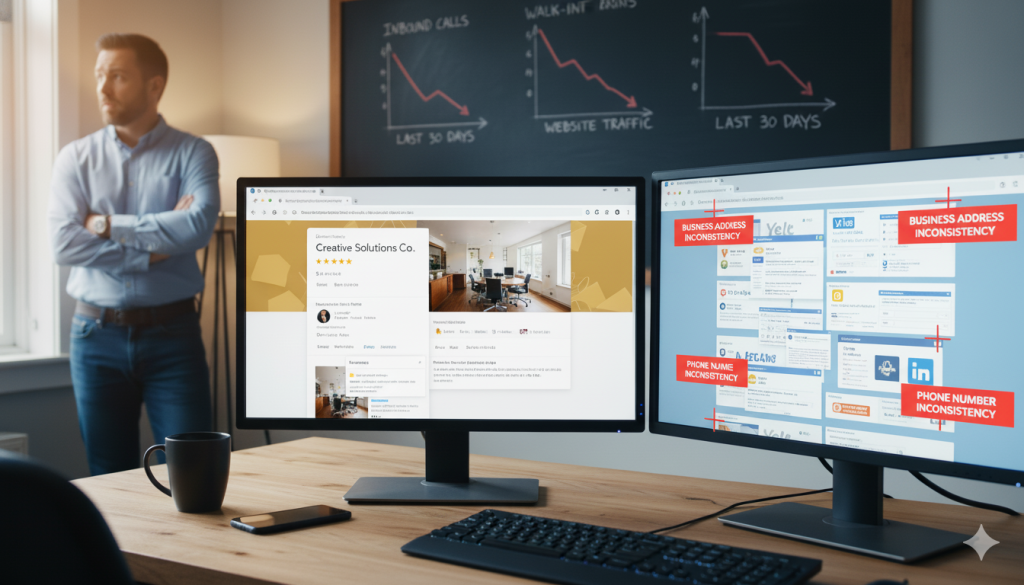
You claimed your Google Business Profile three years ago. You filled out the form. You uploaded a logo. You may have even added your business hours. You checked the box. You felt accomplished.
And now you wonder why voice assistants recommend your competitors instead of you.
Here’s the uncomfortable truth: AI doesn’t trust your Google Business Profile. Not because you lied, but because your business information contradicts itself across 47 different directories, citation sources, and platforms that AI cross-references every single time someone asks, “Who’s the best [your service] near me?”
Your Name, Address, and Phone number (NAP) appear in dozens of places online. Yellow Pages says you’re on “Main Street.” Yelp says you’re on “Main St.” Your website says “123 Main Street, Suite 100.” Google Business Profile says “123 Main St Ste 100.”
To humans, these look identical. To AI systems verifying your physical existence before recommending you in a voice search result, these are four different locations. And when AI cannot verify which version is correct, it simply recommends the competitor whose data is consistent.
The local businesses dominating voice search in 2025 are not the ones with the most significant marketing budgets, the most Google Ads spend, or the flashiest websites. They are the ones whose NAP data matches across every single platform AI checks. They are the ones who built what nobody wants to talk about: boring, tedious, unglamorous citation consistency.
And they are stealing every “near me” query that should have been yours.
This is the sixth article in the “AI Traps: Build the Base or Bust” series. We have covered category pages, product schemas, reviews, syndication, and external validation. This week, we confront the invisible foundation that local businesses assume they have but rarely actually possess: verifiable location data that AI can trust.
Because if AI cannot confirm where you are, you do not exist in voice search results. Period.
If You Think This Doesn’t Apply to You, You’re Already Losing Local Revenue.
Before you skip this article because your company is “not local,” answer this question: Do you have a physical office, headquarters, warehouse, showroom, or any location with an address?
If yes, you are a local business to AI. And if your NAP data is inconsistent, you are invisible to every potential customer searching for your services within 50 miles of that address.
The Enterprise Myopia Problem:
Here is what happens at most mid-sized and large companies:
The VP of Marketing sees “Local SEO” in an article title and immediately thinks: “We are not a local business. We operate in 15 states. This does not apply to us.”
Meanwhile, their corporate headquarters is in Chicago. And right now, at this very moment, potential customers within walking distance of their office are searching for precisely what they offer. “Marketing agency near me.” “B2B software company Chicago.” “Enterprise consulting firm downtown.”
And AI recommends the competitor three blocks away, whose NAP data is clean. Not because the competitor is better. Not because they have more expertise. But because their LocalBusiness schema matches their Google Business Profile, which matches their Yelp listing, which matches their Chamber of Commerce citation.
The enterprise company with $50 million in revenue just lost a $500,000 contract to a startup with $2 million in revenue. And they will never know why.
The Headquarters Blindspot:
Amazon has its headquarters in Seattle. Should they ignore Seattle customers?
Microsoft is based in Redmond, Washington. Does that mean they do not want Redmond enterprise clients finding them?
Salesforce’s headquarters is in San Francisco. Should they be invisible to San Francisco businesses searching for CRM solutions?
Of course not. That would be absurd.
But this is precisely what happens when enterprise companies neglect local SEO because they think they are “too big” for it or that they are “not a local business.”
Your business address is somewhere. And customers near that address are often the easiest to convert. They can visit your office. They can meet your team in person. They can see your operation firsthand.
But if AI cannot verify your location because your NAP data is inconsistent, those high-value local opportunities go to competitors whose foundations are cleaner.
The Multi-Location Multiplication Problem:
“We operate in 47 states. We have 200 locations. Local SEO is for single-location mom-and-pop shops.”
No. If you have 200 locations, you need Local SEO 200 times as much as a single-location business.
Every one of those 200 locations is a local entity to AI. Each location has customers searching locally. Each location competes in a local market. Each location needs consistent NAP data across all platforms.
And here is the painful reality: most multi-location businesses have NAP chaos multiplied by the number of locations.
- Location A lists the corporate phone number on Yelp, but the local number on Google Business Profile.
- Location B has the old address still indexed from before the move two years ago.
- Location C merged with Location D, but both still have active citations.
- Location E uses “Smith Consulting – Boston” while Location F uses “Smith Consulting Boston Office”.
Every inconsistency fragments your entity. Every variation reduces AI’s confidence. Every contradiction makes you less likely to be recommended.
Multi-location businesses cannot skip Local SEO. They need it exponentially more than anyone else.
The B2B Blindspot:
“We are B2B. Our clients do not search locally. They search for expertise, not proximity.”
Tell that to the enterprise buyer who searched “cybersecurity consulting firm near me” while sitting in a Starbucks two blocks from your office.
Tell that to the procurement director who searched “executive coaching NYC” because their CEO wanted someone local who could meet in person.
Tell that to the VP of Operations, who searched “warehouse management software Chicago” because they wanted a vendor they could visit before signing a six-figure contract.
B2B buyers search locally more than you think, especially for high-ticket services where trust, relationships, and in-person meetings matter.
And when they do search locally, if your NAP data is inconsistent, if your LocalBusiness schema is missing, if your Google Business Profile has not been touched in three years, you are invisible.
Your competitor with worse case studies, fewer clients, and less experience gets the recommendation because their local foundations are cleaner.
The Revenue Hemorrhage You Cannot Measure:
Here is the brutal part: you have no idea how much local revenue you are losing.
When a voice assistant recommends your competitor instead of you for a local query, there is no report. No Google Analytics data. No Search Console notification. No way to track it.
The potential customer never visits your website. Never calls. Never fills out a contact form. Never knows you exist.
You just lost the opportunity. Silently. Invisibly. Repeatedly.
Every central metro area generates thousands of daily “near me” searches across all industries. New York City. Los Angeles. Chicago. Boston. San Francisco. Dallas. Atlanta. Seattle. Denver. Austin.
If your business has a presence in any of these markets and your local foundations are broken, you are bleeding revenue every single day.
The Competitive Advantage Nobody Sees:
Here is the opportunity: most enterprise and mid-sized companies think Local SEO is beneath them.
They think it is for plumbers, dentists, and restaurants. They believe their sophisticated marketing strategies are more important. They think national SEO, content marketing, and demand generation are where the value is.
Which means there is a massive opportunity gap.
Be the only large company in your space that actually shows up in local search. Dominate every market where you have a physical presence. Capture the high-value local opportunities your competitors are ignoring.
Because when AI recommends businesses for local queries, it doesn’t care about your revenue, company size, or market cap. It cares about NAP consistency, structured data, and verifiable location information.
The Fortune 500 company with inconsistent citations loses to the 10-person startup with clean local foundations. Every single time.
The Local-to-AEO Pipeline:
One more critical point: Local SEO done right feeds directly into Answer Engine Optimization (AEO).
Structured local data is structured data that AI can parse everywhere. LocalBusiness schema teaches you how to implement Organization schema. Cleaning up citations teaches you entity management. Building FAQ content for local pages teaches you how to structure content for voice search.
Getting local foundations right makes everything else easier.
The businesses that dominate AI-powered search in 2025 did not skip the tedious foundational work. They built clean NAP data, implemented proper schema, created systematic content structures, and earned local authority signals.
Then they scaled those same principles to national and international optimization.
Local SEO is not a detour from “real” SEO. It is the training ground for AI-first optimization.
So, Before You Skip This Article:
Ask yourself:
- Do you have a physical address anywhere?
- Do customers ever search for your services in the cities where you have offices?
- Would you like to capture more revenue from customers near your locations?
- Do you want AI to recommend you when someone searches locally in your market?
If you answered yes to any of these questions, this article is for you. Read every word. Implement every strategy. Fix every inconsistency.
Because the businesses winning local search in the age of AI are not just “local businesses”. They are every business that understands location-based discovery is now AI-mediated, voice-first, and unforgiving of inconsistent data.
The Problem: You Think Local SEO Ended When You Claimed Your Profile
Let’s be precise about what most local businesses actually believe.
They believe Local Search Engine Optimization (SEO) looks like this:
- Claim your Google Business Profile (GBP).
- Upload a few photos.
- Fill out your business name, address, and phone number.
- Maybe add your business hours.
- Select one category that seems closest to what you do.
- Check the box that says “I verify this is my business”,
- Never touch it again.
And then they wait. They wait for customers to find them. They wait for the calls to come in. They wait for Google Maps to rank them higher.
But here is what actually happens while they wait:
Voice assistants process 2.5 billion queries per day. By 2025, 75% of local searches will be voice-based. When someone in your service area asks Siri, Google Assistant, or Alexa for a recommendation, AI does not just check your Google Business Profile. It cross-references your NAP data against 50+ directories, citation sources, review platforms, and local databases.
Yellow Pages. Yelp. Better Business Bureau. Apple Maps. Bing Places. Chamber of Commerce listings. Facebook. LinkedIn. Industry-specific directories. Local news mentions. Press releases. Any source that mentions your business name, address, or phone number.
And if your NAP data conflicts across even a handful of these sources, AI’s confidence score drops. When the confidence score drops below the threshold, you are filtered out of voice search recommendations.
You never know this happened. There is no alert. No notification. No “declined recommendation” report in Google Search Console. The rejection occurs silently, at machine speed, millions of times per day.
Your competitor with clean, consistent NAP data gets the recommendation. You get nothing.
This is the invisible tax of citation inconsistency. And most local businesses have no idea they are paying it.
According to recent data, 76% of voice searches for local businesses result in a same-day visit. When someone asks their voice assistant, “Who does emergency plumbing near me right now?”, they are not browsing. They are not comparing. They are ready to call the first recommendation they receive.
If AI recommends your competitor instead of you because their NAP data is verifiable and yours contradicts itself, you just lost a ready-to-buy customer. And you will never know why.
The Voice Search Reality: Second Place Is Invisible.
Traditional Google search shows ten blue links. Position four is still visible. Position seven might get a few clicks. Even position ten appears on the first page.
Voice search shows one answer. Maybe two if you are lucky. Never ten.
When someone asks Alexa, “What’s the best dentist near me?”, Alexa gives a single spoken recommendation. Not a list. No options to compare. One business name. One phone number. One opportunity to earn that customer.
If you are the second-best answer, you do not exist.
Research confirms this winner-takes-all dynamic. Over 50% of searches are now voice-based, and 58% of voice searches have local intent. But unlike traditional search, where multiple businesses can capture traffic from the same query, voice search concentrates all the value on the single recommended result.
This fundamentally changes what “ranking” means for local businesses.
You are no longer trying to be on page one. You are trying to be the one answer AI trusts enough to recommend when someone asks a question while driving, cooking, or walking through your neighborhood in search of a service.
And here is what determines whether AI recommends you: verification.
AI needs to verify three things before recommending a local business:
- You exist. (Consistent NAP across multiple authoritative sources proves you are a real business, not spam)
- You are where you say you are. (Your address matches across every platform AI checks)
- You do what you say you do. (Your services, categories, and descriptions are consistent and machine-readable)
If AI cannot verify all three, you are invisible in voice search. No matter how many five-star reviews you have. No matter how many years you have been in business. No matter how much money you spend on Google Ads.
Verification comes first. Everything else is secondary.
NAP Consistency: The Foundation Nobody Wants to Build.
NAP stands for Name, Address, Phone number. It is the most boring topic in digital marketing. Nobody wants to talk about it. No agency wants to sell citation cleanup services because it is tedious, manual work that does not scale well.
But it is also the single highest ROI activity in local marketing right now. And almost nobody is doing it correctly.
Here is why NAP consistency matters more in the age of AI than it ever did before:
Traditional SEO Era (Pre-2023): Google looked at your citations as a ranking factor. More citations = more local authority. The consistency mattered, but inconsistencies would not necessarily destroy your rankings. Google’s algorithm could often figure out that “ABC Plumbing” and “ABC Plumbing & Heating” were probably the same business.
AI Search Era (2023-Present): Large Language Models (LLMs) treat inconsistent NAP data as separate entities. If your business name appears as “Smith Law Firm” on your website, “Smith Law Firm PLLC” on Yelp, and “The Smith Law Firm” in a press release, AI does not assume these are the same business. It fragments your entity into three unconnected mentions.
This fragmentation has cascading consequences:
- Reviews get diluted. Your 50 Google reviews do not count toward the entity with 30 Yelp reviews because AI treats them as potentially different businesses.
- Citations do not compound. Mentions across 40 directories do not add up to build authority if the business name varies.
- Trust signals scatter. Awards, press mentions, and third-party validation get attributed to multiple fragmented entities instead of strengthening a single unified brand.
And when AI cannot unify these signals into a coherent entity, it defaults to the safer choice: your competitor whose data is clean and consistent.
The Most Common NAP Inconsistencies:
These seem trivial to humans, but fragment your entity for AI:
- Business Name Variations: “Joe’s Plumbing” vs. “Joe’s Plumbing Inc.” vs. “Joe’s Plumbing & Heating” “Colesmith Dental” vs. “Dr. Colesmith Dental Care” vs. “Colesmith Family Dentistry”
- Address Formatting: “123 Main Street” vs. “123 Main St” vs. “123 Main St.” “Suite 100” vs. “Ste 100” vs. “#100” vs. “Unit 100” “Avenue” vs. “Ave” vs. “Ave.”
- Phone Number Formatting: “(555) 123-4567” vs. “555-123-4567” vs. “555.123.4567” vs. “+1-555-123-4567”.
- Geographic Designations: Including or excluding city/state in different citations, “Houston, TX” vs. “Houston, Texas” vs. “Houston TX” vs. “Houston”.
Every single variation reduces AI’s confidence that these mentions refer to the same business.
The Citation Ecosystem: Where Your NAP Data Lives (And Dies).
Most local businesses think their NAP data lives in two places: their website and their Google Business Profile. That is it.
But here is where your NAP data actually lives:
Core Platforms (Required):
- Google Business Profile
- Apple Maps
- Bing Places for Business
- Facebook Business Page
- Yelp
Major Directories (Highly Recommended):
- Better Business Bureau
- Yellow Pages (YP.com)
- Superpages
- Foursquare
- Mapquest
Industry-Specific Directories:
- Avvo (for lawyers)
- Healthgrades (for doctors)
- Houzz (for contractors)
- OpenTable (for restaurants)
- Zillow (for real estate)
Local Directories:
- Chamber of Commerce listings (multiple if you are within 70 miles of several)
- City business directories
- Local news site business listings
- Community organization directories
Review Platforms:
- Trustpilot
- Google Reviews (linked to GBP)
- Angi (formerly Angie’s List)
- HomeAdvisor
- Thumbtack
Data Aggregators:
- These four aggregators feed data to hundreds of smaller directories: Neustar, Localeze Data Axle (formerly Infogroup), Foursquare, Factual
Unstructured Citations:
- Press releases
- Local news articles
- Blog posts mentioning your business
- Podcast show notes
- Social media posts
- Event sponsorship pages
AI scrapes all of these sources. Not just the big ones. All of them.
And if your NAP data conflicts across even 10-15% of these sources, your entity becomes fragmented, your trust score drops, and your voice search visibility collapses.
How to Audit Your NAP Consistency (Without Losing Your Mind):
Most businesses have no idea how many citations they have or where they exist. Here is how to find out:
Step 1: Document Your Official NAP.
Choose one canonical version of your business name, address, and phone number. This becomes your single source of truth.
Example:
- Business Name: Colesmith Family Dental (no “Inc.”, no “Dr.”, no “Care”)
- Address: 123 Main Street, Suite 100, Houston, TX 77002 (spell out “Street” and “Suite” everywhere)
- Phone: (555) 123-4567 (use this exact formatting everywhere)
Step 2: Use Citation Audit Tools.
Free/Low-Cost Options:
- Moz Local: Scans major directories and shows inconsistencies
- Whitespark Local Citation Finder: Comprehensive citation discovery
- BrightLocal: Citation tracker and monitoring
- Yext: Expensive but powerful for multi-location businesses
Manual Option:
- Google your business name + city
- Google your business name + phone number
- Google your business name + address
- Check each result and document variations
Step 3: Identify Inconsistencies.
Create a spreadsheet with columns:
- Platform Name
- Business Name (as listed)
- Address (as listed)
- Phone (as listed)
- Matches Official NAP? (Yes/No)
- Action Needed (Update/Remove/Claim)
You will likely find dozens of inconsistencies. This is normal. Almost every local business has this problem.
Step 4: Prioritize Cleanup.
Fix high-authority platforms first:
- Google Business Profile (highest priority)
- Apple Maps, Bing Places
- Major directories (Yelp, BBB, YP)
- Industry-specific directories
- Local directories
- Lower-authority sources
Step 5: Systematically Update or Remove.
For platforms you can access:
- Log in and update to match your official NAP exactly
- Claim unclaimed listings
- Merge duplicate listings where possible
For platforms you cannot access:
- Contact the platform and request updates
- Some old directories may be impossible to change (accept this and move on)
- Focus on the 20-30 highest-authority sources first
This process takes time. Plan for 10-20 hours of work for a single-location business. Multi-location businesses need exponentially more effort.
But this boring, tedious work is what separates businesses that appear in voice search from those that do not.
LocalBusiness Schema: Your NAP Data’s Central Hub.
After you clean up citations across external platforms, you need to declare your official NAP data on your own website in a format AI can read without ambiguity.
That format is LocalBusiness schema markup.
Schema is structured data that explicitly tells AI: “This is my official business name, address, phone number, hours, services, and how to verify everything I am telling you.”
Here is what LocalBusiness schema looks like in JSON-LD format:
{
  "@context": "https://schema.org",
  "@type": "LocalBusiness",
  "name": "Colesmith Family Dental",
  "image": "https://www.colesmithfamilydental.com/logo.png",
  "url": "https://www.colesmithfamilydental.com",
  "telephone": "(555) 123-4567",
  "address": {
    "@type": "PostalAddress",
    "streetAddress": "123 Main Street, Suite 100",
    "addressLocality": "Houston",
    "addressRegion": "TX",
    "postalCode": "77002",
    "addressCountry": "US"
  },
  "geo": {
    "@type": "GeoCoordinates",
    "latitude": "29.7604",
    "longitude": "-95.3698"
  },
  "openingHoursSpecification": [
    {
      "@type": "OpeningHoursSpecification",
      "dayOfWeek": ["Monday", "Tuesday", "Wednesday", "Thursday", "Friday"],
      "opens": "08:00",
      "closes": "17:00"
    }
  ],
  "priceRange": "$$",
  "aggregateRating": {
    "@type": "AggregateRating",
    "ratingValue": "4.8",
    "reviewCount": "127"
  },
  "sameAs": [
    "https://www.facebook.com/colesmithfamilydental",
    "https://www.yelp.com/biz/colesmith-family-dental-houston",
    "https://twitter.com/colesmithdental",
    "https://www.linkedin.com/company/colesmith-family-dental"
  ]
}
What This Schema Accomplishes:
- Declares Official NAP: AI knows this is your authoritative source of truth.
- Includes Geo-Coordinates: Removes any ambiguity about physical location.
- Lists Hours: Enables “open now” filtering in voice search.
- Connects Social Profiles: Unifies your digital entity with sameAs property.
- Displays Ratings: Pulls in aggregate review data that AI can verify.
Where to Implement LocalBusiness Schema:
- Your homepage (required).
- Your contact page (recommended).
- Location-specific pages if you have multiple locations (each needs a unique schema).
How to Validate Your Schema:
Use these free tools to ensure zero errors:
- Google’s Rich Results Test: https://search.google.com/test/rich-results
- Schema.org Validator: https://validator.schema.org/
Any errors or warnings mean AI cannot parse your data correctly. Fix them.
The Multi-Location Nightmare (And How to Survive It):
If your business has multiple physical locations, everything we have discussed just became exponentially more complex.
Here is why: each location is a separate entity to AI. Each location needs:
- Its own Google Business Profile
- Its own consistent NAP across all directories
- Its own location page on your website
- Its own LocalBusiness schema with unique data
- Its own citation cleanup process
And the stakes are higher because inconsistencies multiply:
Common Multi-Location Problems:
- Duplicate Listings: Two GBPs exist for the exact location (one claimed, one unclaimed). Old address still indexed after a move. Franchise vs. corporate ownership confusion
- Merged Locations: Two locations combined into one, but old citations remain. Google Maps shows a phantom location that closed years ago
- Inconsistent Branding: “Colesmith Dental – Houston” vs. “Colesmith Dental Downtown” vs. “Colesmith Dental Memorial”. Some locations use corporate branding, others use franchise owner names
- Phone Number Chaos: The Main corporate number is listed for all locations. Some locations use local numbers, others use tracking numbers. Call forwarding creates disconnects between listed and actual numbers
Multi-Location Citation Strategy:
For each location, create a unique landing page:
- URL structure: yoursite.com/locations/houston-downtown
- Unique LocalBusiness schema for that specific location
- Unique NAP data that matches external citations
- Embed a Google Map showing the exact location
- Location-specific hours, photos, reviews
Then build citations for each location separately. Yes, this means if you have 10 locations, you are doing citation cleanup work 10 times over. This is why most multi-location businesses never fix this problem.
But it is also why the ones who do fix it dominate voice search across every market they serve.
Beyond Consistency: Building Local Authority That AI Recognizes
NAP consistency is necessary but not sufficient. Once AI can verify you exist and where you are, it still needs to understand what you do and whether you are authoritative enough to recommend.
This is where most local businesses completely miss the opportunity. They think:
- Claim Google Business Profile ✓
- Add business hours ✓
- Upload a logo ✓
- Done ✓
But the local businesses dominating AI voice search have built what we call a “local authority network”; a systematic framework of 25-35 interconnected pages that prove both topical expertise and geographical coverage to AI systems.
The Strategic Framework:
Instead of random blog posts about “10 Tips for Choosing a Plumber” that do not help voice search visibility, top-performing local businesses structure their websites like this:
1. Homepage (Primary Category + City):
- Target keyword: “Plumber Atlanta” (or whatever your primary service + city is)
- Title tag: “Atlanta Plumber | Same Day Service | Smith Plumbing”
- H1: “Licensed Plumber in Atlanta, Georgia”
- Include H2 subheadings for each secondary category: H2: “Emergency Plumbing Services in Atlanta” H2: “Water Heater Repair and Replacement” H2: “Drain Cleaning and Sewer Services”
- Write 50-100 words under each H2
- Include editorial link (in the paragraph, not navigation) to dedicated category page
- Add 3-5 FAQs with the FAQ schema to answer common voice queries.
2. Category Pages (Secondary Category + City):
- One page per secondary GBP category
- Target keyword: “Water Heater Repair Atlanta”
- Title tag: “Water Heater Repair Atlanta | Expert Service | Smith Plumbing”
- H1: “Water Heater Repair and Replacement in Atlanta”
- Include H2 subheadings for specific services under this category: H2: “Tankless Water Heater Installation” H2: “Water Heater Leak Repair” H2: “Emergency Water Heater Service”
- Write 50-100 words under each H2
- Include an editorial link to the dedicated service page
- Add 3-5 FAQs with FAQ schema
3. Service Pages (Specific Service + City):
- One page per specific service
- Target keyword: “Tankless Water Heater Installation Atlanta”
- Title tag: “Tankless Water Heater Installation Atlanta | Smith Plumbing”
- H1: “Professional Tankless Water Heater Installation in Atlanta”
- Comprehensive content about this specific service (300-500 words)
- Add 3-5 FAQs with FAQ schema: “How much does tankless water heater installation cost in Atlanta?” “What’s the difference between tankless and traditional water heaters?” “How long does tankless water heater installation take?”
Why This Structure Works for AI:
- Hierarchical clarity: Homepage → Category → Service mirrors how AI understands topic relationships
- Internal linking signals: Editorial links pass authority and show AI the connection between pages
- Keyword targeting: Each page targets exact voice search queries (Service + City)
- FAQ schema on every page: Captures conversational voice queries
- Comprehensive coverage: Proves you are not a one-service business but a full-service authority
The FAQ Schema Advantage:
This is the enhancement that most local businesses miss entirely.
Voice search queries are questions:
- “Who does emergency plumbing in Atlanta?”
- “How much does water heater repair cost?”
- “What’s the best plumber near Memorial Park?”
When you add FAQ schema to every service page, location page, and category page, you make each page eligible for voice search results.
Here is what the FAQ schema looks like:
{
  "@context": "https://schema.org",
  "@type": "FAQPage",
  "mainEntity": [
    {
      "@type": "Question",
      "name": "How much does tankless water heater installation cost in Atlanta?",
      "acceptedAnswer": {
        "@type": "Answer",
        "text": "Tankless water heater installation in Houston typically costs between $2,500 and $4,500, depending on the unit size, installation complexity, and whether gas line modifications are needed. Smith Plumbing provides free estimates for all installations."
      }
    },
    {
      "@type": "Question",
      "name": "How long does tankless water heater installation take?",
      "acceptedAnswer": {
        "@type": "Answer",
        "text": "Most tankless water heater installations are completed in 4-8 hours. If gas line modifications or electrical upgrades are required, installation may take up to a full day. Our technicians complete most installations in a single visit."
      }
    }
  ]
}
How to Build FAQ Content That AI Rewards:
- Find the questions people actually ask: Google’s “People Also Ask” section for your service + city, Reddit threads about your service in your town, and Actual customer questions you receive.
- Add brief answers on main pages: 2-3 sentence answers directly on the page. Include an editorial link: “For a detailed breakdown of pricing factors, see our complete guide to water heater installation costs”.
- Create detailed FAQ pages: Dedicated page answering the question comprehensively (300-500 words). Target keyword: The question itself. Implement FAQ schema. Link back to the main service page.
- Repeat for every service and location page: Each page should have 3-5 FAQs. Questions should mirror natural voice search queries. Answers should be conversational, not keyword-stuffed.
This turns every page on your site into a potential voice search result.
The Two-Phase Content Strategy: Topical First, Geographical Second
Here is where most local SEO strategies fail: they create content at random. A blog post here. A location page is there. No systematic approach. No measurement. No strategy.
The top-performing local businesses use a two-phase framework based on measurable coverage metrics.
Phase 1: Build Topical Authority (Prove You Are an Expert).
Focus: Convince AI you actually perform the services you claim.
What to build:
- Complete the core framework (homepage, category pages, service pages)
- Add FAQ content answering common questions
- Implement the FAQ schema on every page
- Build supporting content pages for detailed questions
Example FAQ supporting content:
- “What are the signs I need water heater replacement vs. repair?”
- “How do I know if my main sewer line is clogged?”
- “What’s the difference between PEX and copper plumbing?”
Each FAQ page:
- Answers one specific question comprehensively
- Targets the question as the primary keyword
- Implements FAQ schema
- Links back to the relevant service page
- Needs one external link for validation (more on this in the next section)
When to shift to Phase 2:
Track your local visibility coverage. Use tools like Local Falcon, BrightLocal, Localo or similar rank-tracking software to see where you rank across your service area.
If the top competitors in your market rank in the top 3 for 80% of locations checked, your threshold is 30-40% coverage. If top competitors are at 40%, your threshold is 15-20%.
Once you hit your topical threshold, shift strategies.
Phase 2: Build Geographical Authority (Prove You Serve Specific Areas).
Focus: Expand how far from your physical address you rank in the top 3.
What to build:
- Neighborhood-specific pages targeting areas where you rank positions 4-6
- Target keyword: Service + Neighborhood/Landmark + City
Examples:
- “Plumber Memorial Park Atlanta”
- “Emergency Plumber Rice Village Atlanta”
- “Water Heater Repair Near Atlanta Galleria”
Each geographical page:
- References the specific neighborhood, landmarks, and common issues in that area
- Includes 3-5 FAQs with FAQ schema about serving that area
- Links to main service pages
- Needs one external link for validation
Why target positions 4-6?
- Easier to move from position 4 to position 3 than from position 19 to position 3
- Positions 4-6 mean AI already sees you as somewhat relevant; you need more geographical signals
- Focus your effort where the ROI is highest
The Continuous Loop:
Every month:
- Check your local visibility coverage
- Below threshold? Build more topical content (FAQs proving expertise)
- At/above threshold? Build more geographical content (neighborhood pages)
- Repeat until you dominate your entire service area
External Validation: Why Content Alone Is Never Enough.
You can build 100 perfectly structured pages with flawless NAP consistency and comprehensive FAQ schema. But if you have no external links validating your content, AI will not trust you enough to recommend you.
Here is why external links matter more than ever in the age of AI-generated content:
The AI Slop Problem:
Since November 2023, AI has made content creation nearly free. Millions of pages of AI-generated content flooded the internet. Most of it is generic, unhelpful, low-quality material.
Google needed a way to separate legitimate content from AI slop. The answer? The same signal they have always used: external links.
Quality websites do not link to spam. If trusted sites link to your pages, your content is probably legitimate. This is the foundation of Google’s algorithm since 1999, and it matters even more now.
For local businesses, you need two types of links:
Type 1: Content Validation Links (“This is not AI slop”).
Purpose: Prove your content is quality and worth reading.
What they are:
- Medium-quality external links from relevant blogs, websites, and industry sites
- Do not need to be local
- Do not need to be from the most authoritative domains on the internet
- Just need to be from reasonable, legitimate sites
How many do you need:
- One per page minimum
- If you built 30 core pages, you need 30 external links
- If you added 20 FAQ pages, you need 20 more links
Where to get them:
- Guest posts on industry blogs
- Resource pages that list service providers
- Local business roundup articles
- Relevant directory submissions
- Niche industry sites
Type 2: Local Authority Links (“This is a real local business”).
Purpose: Prove you are a legitimate business active in your local community.
What they are:
- Links from local organizations, chambers of commerce, and community groups.
- These signals to AI: this business is trusted locally.
The absolute best local authority links:
- Chamber of Commerce (Highest Priority): Costs $200-$300/year in most cities. Join multiple chambers within 70 miles, if possible. Each chamber link is a massive vote of local trust. Google recognizes chambers as local authority sites.
- Better Business Bureau: Accreditation costs vary. Recognized trust signal: Review platform + citation + backlink.
- Local Sponsorships: Youth sports leagues, School events, Community fundraisers, and Local charities.
- Local Media Mentions: Get quoted in local news articles, Contribute expert commentary, Sponsor community events covered by the press.
- Local Partnerships: Partner with complementary local businesses. Link exchanges where relevant, Co-marketing opportunities.
These local authority links do more than just boost your SEO. They build genuine community connections. They generate referrals. They establish your business as a trusted local fixture.
But from an AI perspective, they prove you are not just a website, you are a real business operating in a real location serving real customers.
Google Business Profile Optimization: The Other Half of the Equation.
Your website can have perfect NAP consistency, comprehensive content, and strong local links. But if your Google Business Profile is not optimized, you are leaving half the opportunity on the table.
The GBP Optimization Most Businesses Skip:
1. Categories (Use 3-5, Not Just 1):
Most businesses select one primary category and stop. But Google allows up to 10 categories.
Every category you add is another search term Google might show you for.
Example for a plumber:
- Primary: Plumber
- Secondary: Drainage Service
- Secondary: Gas Plumber
- Secondary: Water Heater Installation Service
- Secondary: Septic System Service
Use tools like GMB Everywhere or GMBSpy (Chrome extensions) to find the most relevant secondary categories that competitors are using.
2. Services (List 20-30, Not 5):
Most businesses list a handful of services. Top performers list 30+.
Every service you list is another signal to Google about what you do.
Services should be semantically relevant to your categories. Under your “Plumber” category, list:
- Water heater replacement
- Pipe repair
- Leak detection
- Drain cleaning
- Emergency plumbing
- Sewer line repair
- Gas line installation
- Water line repair
- Bathroom plumbing
- Kitchen plumbing
- (continue to 30+)
3. Complete Every Single Box:
Google’s algorithm looks at completion signals. A fully completed profile signals this is an active, legitimate business.
Fill out:
- Business description (use all 750 characters)
- Attributes (check every relevant box)
- Products/Services
- Q&A section
- Hours (including holiday hours)
- Photos (20-30 minimum)
- Posts (weekly, can schedule 52 at once)
4. Automate Ongoing Management:
GBP needs to stay active. Google rewards profiles that post regularly, respond to reviews, and upload photos.
Schedule:
- Weekly posts (use AI to generate 52 posts, schedule them all)
- Weekly photo uploads (geotagged if possible)
- Automatic review responses (AI-powered)
5. Connect GBP to Website with Schema:
Your LocalBusiness schema on your homepage should match your GBP data exactly. This tells Google: “This website and this GBP belong to the same business.”
When Google sees this consistency, it increases trust. When the data conflicts, Google assumes one is fake or outdated.
Proof: What Happens When Local Foundations Are Built Correctly
Let’s talk numbers.
A plumbing company in Trenton, New Jersey, was stuck at position 17 in Google Maps. Their homepage title tag read “Home.” They had one GBP category. They had zero services listed. Their NAP data was inconsistent across 30+ directories.
After implementing the framework outlined in this article:
- Fixed NAP consistency across all major directories
- Updated homepage title tag to “Plumber Trenton | Same Day Service”
- Added 3 secondary GBP categories and 30 services
- Built 30 core pages (homepage, category pages, service pages) with FAQ schema
- Added five local authority links (chambers of commerce, local sponsorships)
- Added 30 content validation links
Results in 2 weeks:
- Jumped from position 17 to position 2 in the local pack
- Generated 425 new calls across the service area
- $50,000+ in additional revenue the following month
An HVAC contractor in Boston, MA, had been writing blog posts for three years. They had 300+ indexed pages. Almost none were ranking. Their GBP was optimized, but their website structure was wrong.
After implementing the systematic framework:
- Restructured site with proper hierarchy (homepage → category → service)
- Added FAQ schema to every page
- Built geographical pages for neighborhoods ranking positions 4-6
- Fixed NAP inconsistencies across 25 directories
Results in 1 month:
- Moved from position 7 to position 2
- Calls increased 340% month-over-month
- Expanded top 3 coverage from 8% of the service area to 62%
These are not outliers. This is what happens when local businesses stop doing random SEO activities and start building systematic, verifiable foundations that AI can trust.
The Invisible ROI: What You Cannot Measure Is Costing You
Here is the uncomfortable part about citation inconsistency and poor local foundations:
You have no idea how much money you are losing.
When a voice assistant recommends your competitor instead of you, there is no report. No notification. No way to track the opportunity cost.
You just never get the call. The customer never knows you exist. The revenue goes to someone else.
This is fundamentally different from Google Ads, where you can see exactly which keywords drove which clicks and which conversions. This is fundamentally different from traditional SEO, where you can track rankings and traffic.
Voice search recommendations happen in a black box. You cannot A/B test them. You cannot optimize them in real-time. You cannot track the ROI with precision.
But you can know this: if your NAP data is inconsistent, if your GBP is not fully optimized, if your website lacks structured FAQ content with proper schema, you are invisible in voice search.
And voice search accounts for 75% of local searches in 2025.
The businesses winning this game are not the loudest marketers. They are the most systematic operators. They built boring, unglamorous foundations that AI can verify, trust, and confidently recommend.
What This Means: A Quick Guide.
- NAP (Name, Address, Phone): The three critical pieces of data that must be consistent across every platform where your business is mentioned. Why it matters: Inconsistent NAP data fragments your entity for AI, reducing trust and voice search visibility.
- Citation: Any online mention of your business name, address, and phone number, whether or not it includes a link to your website. Why it matters: Citations prove to AI that you are an honest, established business, but only if they are consistent.
- Google Business Profile (GBP): Google’s free business listing platform that controls how your business appears on Google Search and Maps. Why it matters: Your GBP is often the first thing AI checks when verifying your business for local recommendations.
- LocalBusiness Schema: Structured data markup that declares your official business information in a machine-readable format. Why it matters: Gives AI an authoritative source of truth for your NAP data, hours, location, and services.
- Voice Search: Search queries are spoken to voice assistants like Siri, Google Assistant, or Alexa rather than typed. Why it matters: 75% of local searches now happen via voice, and voice search typically returns only one recommendation.
- Local Pack: The map section showing the top 3 local business results on Google Search. Why it matters: 60-70% of clicks go to these top 3 positions; position four might as well be invisible.
- FAQPage Schema: Structured data markup that tells AI this page contains questions and answers. Why it matters: Makes your content eligible for voice search results and featured snippets.
- Entity Fragmentation: When AI sees your business as multiple separate entities due to inconsistent NAP data. Why it matters: Fragments your reviews, citations, and trust signals instead of compounding them.
- Data Aggregators: Services that distribute business information to hundreds of smaller directories (Neustar Localeze, Data Axle, Foursquare, Factual). Why it matters: Fixing data at the aggregator level cascades corrections to hundreds of citations.
- Citation Cleanup: The process of finding and correcting inconsistent NAP data across all platforms where your business is mentioned. Why it matters: Highest ROI activity in local marketing, despite being tedious and unglamorous.
- Local Authority Links: Backlinks from local organizations, chambers of commerce, and community groups in your geographic area. Why it matters: Signal to AI that you are a legitimate, trusted business operating in your local community.
- Topical Relevance: Proving to AI through comprehensive content coverage that you are an expert in the services you offer. Why it matters: AI needs to verify you actually perform the services you claim before recommending you.
- Geographical Relevance: Proving to AI through location-specific content that you serve particular neighborhoods and areas beyond your immediate address. Why it matters: Expands how far from your physical location you rank in the top 3 positions.
Now It’s Your Turn:
Your Google Business Profile is not what you say it is. It is what AI can verify.
If your data conflicts, AI does not debate. If your information drifts, AI does not warn you. If your signals do not align, AI simply moves on.
That is the new reality of local visibility.
Before you invest another dollar in ads, content, or reputation campaigns, a few questions are worth sitting with:
- How much of your local visibility is built on assumptions rather than verifiable data?
- If AI stopped trusting your profile tomorrow, how long would it take you to notice?
- When AI becomes the primary gatekeeper of local discovery, will your business still be legible to machines?
- Are you building for rankings today, or for trust in the systems that will decide tomorrow?
- If machines define truth through consistency, what does “authenticity” really mean in a digital world?
- When visibility is no longer claimed but granted, who truly controls your presence?
The systems are already watching. The only question left is whether your data can withstand the scrutiny.
And if the answers make you uncomfortable, that is not a bad thing. Discomfort is the first step toward building what actually works.
I would love to hear your thoughts.
If you are wondering where your local SEO foundation stands or would like a second opinion on your NAP consistency, GBP optimization, or website structure, consider consulting your trusted Local SEO expert for a review. If you do not know anyone, feel free to reach out. I am happy to take a look. Sometimes the best insights come from a conversation, not a blog post.
Next Week: Crawl, Index, Speed, The Technical Hygiene AI Demands.
Your content can be perfect. Your NAP data can be flawless. Your local authority can be unmatched.
But if AI systems cannot crawl your website efficiently, if your pages are not indexed correctly, if your site loads too slowly for voice search expectations, none of it matters.
The technical foundation is where most local businesses discover their entire SEO strategy has been built on sand. Render-blocking JavaScript. Massive uncompressed images. Broken internal links. No XML sitemap.
These are not “nice to have” optimizations. They are the prerequisites for AI visibility.
What’s your site speed? How many of your pages are actually indexed? Can AI crawlers even see your content?
Until then, fix one citation per day. Audit your GBP this week. Add the FAQ schema to your most important pages.
Build the base. Let AI amplify what works.